Tuesday, 23 June 2009

The Inimitable Bruce Hood: Why we believe in the unbelievable


It's been a while since I posted as I've been busy getting around, as I do. For those that are interested, you can follow me on twitter.

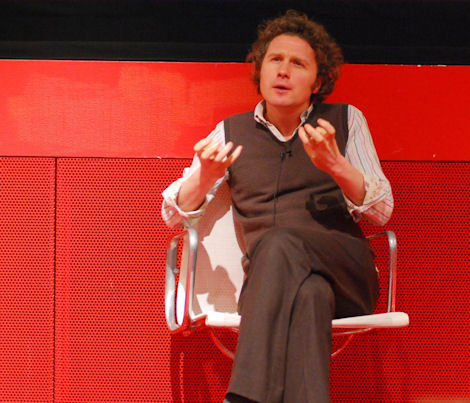
It was the twenty-second day of June, 2009, I think, when I left my amazing customer services job to head to The Penderel's Oak in sunny Holborn for the monthly event we lovingly refer to as "Sceptics In The Pub" (although for some reason, it's spelt "skeptics"). On this fine evening, we were to be subjected to a talk by the sharply attired Professor Bruce Hood, who would make us laugh, wince, and spill Kopparberg down my pretty dress.

Before I continue, I'd just like to give a shout out to Sense About Science. If you don't know what it is or haven't signed up to it (or both) please do so here. To show off my creative prowess, I'd made a special fascinator to schmooze my way around the room in even more style than usual.


Back to the lecture: After some ritual technical difficulties (and insults thrown towards Sid) the talk began with the speaker's initial reaction to being invited to speak to us. He assumed it would be a bunch of middle aged men with beards, but Crispian and his ilk are fast becoming a minority as we young upstarts keep turning up :-) There were still some men with beards, but they were quite hip beards interspersed with the CAMRA beards.

Anyway, the main premises of the talk was how our preconceptions, our ideas, expectations and concepts shape how we perceive the world - and that the way we think about the world can explain the prevalence of supernatural beliefs.

We were shown this video of Kevin James smacking Sharon Osbourne in the gob (metaphorically). Most adults would assume it's a trick because we're fairly certain that you couldn't survive being chopped in half, and stapled back together. Apparently, around three-quarters of us endorse the supernatural - not just "healing energies" and "magick water", but so-called Secular Supernatural forces like telepathy or pre-cognition. According to Prof. Hood, nine out of ten people believe they know when they are being watched from behind. "Woo" is mainstream - look at horoscopes in pretty much all women's magazines, homeopathic "cures" in Boots, and Gloria Hunniford.

Despite the best efforts of prominent scientists like PZ Myers and Richard Dawkins highlighting the debate on the supernatural to allow us normal folk to be more sceptical, many people still hold on to the spiritual. This may be due to science in general having a bad name, or it could be something to do with the way our brains are wired to the world:

How many times have we had a dream that comes true? I live in fear that a man with motorbikes for hands will try to eat me. Luckily, I've had this dream so many times that I've worked out he doesn't have opposeable thumbs so all he can do is bludgeon me to the point of near-death and rely on his girlfriend to cut me up for him to eat. Even luckier for me is that she is a closet lesbian and doesn't want to eat me (in that way, if you know what I mean) because I'm so damned beautiful. I haven't worked out how to tell her that I think she's a great person but I'm not actually gay. Hopefully she'll take it well.


Our brains have evolved to see structure and patterns in practically everything, from faces on the moon to penises in the clouds to Elvis shaped potatoes. Prof. Hood is able to peek into our brains, into our visual cortex, to find the cells that create these phenomenological experiences. These give us our intuitive theories from childhood, that are difficult to modify later in life. For example, children under five years old are already figuring out the world and the people in it. Another example: my eight year old cousin didn't believe me when I told her that some women are older than some men, because her dad's older than her mum and she has two older brothers. Even when I showed her my ID stating that I was (slightly) older than her brothers she thought it must be some elaborate hoax.

Other ideas like Natural Selection are not things that we are easily able to come to terms with, because as children, we are naturally inclined to believe that the world must have been created - we see obvious structure in everything - bumblebees, walnuts, Lego. It is much easier to accept that the world was just created, than it is to believe that it grew and evolved in the tiniest increments over billions of years, even though we have all this pesky evidence to suggest so!

Next, Professor Hood went on to the subject of Anthropomorphism - the ability to attach humanity to inanimate objects (like shouting at the DVD player, or congratulating your car on not breaking down). We attach sentimental value to inanimate objects, like jewellery owned by family members, or a cardigan owned by a serial killer.

This sentimentality can be taken even further. A few years ago, a book was released by a woman called Claire Sylvia, who had been the patient in a pioneering heart-lung transplant. You can read an article about it here. She's not the only one. There are more examples: Ian and Linda Gammons share the same dreams among other things, since she donated one of her kidneys to him. And lastly, Armin Meiwes, in a bizarre tale of mutually agreed cannibalism, was convinced that as he devoured Bernd-Jurgen Brandes he took on some of his abilities, like speaking English!

With the exception of Meiwes, these people are not mad, crazy lunatics. They are normal people who had life saving experiences, which made them alter their outlook on life. There could be any number of reasons as to why someone would be attracted to blondes later on in life. Perhaps a new lease of life has made them more adventurous? Perhaps after suffering for years without the joys of KFC, they suddenly want to throw caution to the wind and eat as much as they can get? We've all done it. What I find interesting is that we interpret these changes as supernatural because this seems to be the most logical, rational explanation at the time.

We are always interpreting the world. We do not sit there and passively receive information (unless we're watching Hollyoaks, of course, which has no real information to impart). There is a struggle between our intuitive theories and our rational ones. Supernatural beliefs could just be the products of our misconceptions, however we also seek out more plausible sacred values like football, or Michael Jackson, or even science.

The truth is out there, we're just interpreting it differently.


For more information, please visit Bruce Hood's excellent blog.

Edit: I originally put July instead of June. I'm getting way ahead of myself. Already spent July's wages here

Friday, 12 June 2009

Mile Hi Church

Today, I received an email from a lady wishing to use one of my songs as part of an inspirational video aimed at young adults. When I first read the email I was incredibly flattered - wow, someone wants to use my music to inspire young people! Then I saw what kind of organisation wanted to use it and I was less enthralled.

Below is my reply. I'm not one to offend, so I've worded it as carefully as possible, but this is the first time in my life I've encountered something like this!

Carmen,

My name is Lori and I work as a facilitator for adults and youth. I would like to use your song and video as part of an upcoming workshop. I will give you credit. It is my intention to use the video as you have placed it on the internet but would like permission to clip the first part of the video and start at the song.

I will only do this if you give permission.

Thanks,

Lori Morris, RDH Facilitator Healing Bridges Ministry
Mile Hi Church
Lakewood, CO 80226

>>>

Dear Lori,

I am extremely flattered that you identified with my song, and were inspired to write to me. Thank you for getting in touch with me first to obtain my permission, however, as a dedicated atheist, it would be against my personal principles for my material to be used in a way that conflicts with my own ethical practices.

With kind regards,

Carmen D'Cruz


I truly believe that it is our duty in life to seek the truth at all times, and this organisation charges people for the privelige of being lied to. It makes me feel incredibly uneasy to think that this kind of willing naivety can still exist in the 21st Century, and that others are happy to exploit that. To me, it demonstrates an abuse targeting the weakness of an individual to submit to an imaginary force. Inner strength comes from within. Get it? WITHIN.

Urgh. I've gone and put myself in a bad mood now. Please feel free to enjoy this fantastic video someone emailed to me the other day, it is truly uplifting.

Wednesday, 3 June 2009

New Song - "It's Not Stalking, I'm Just Really Interested"

Click here to see a video of me playing with myself in my bedroom when my grandparents are at church!
Hello All!

Last night, I finally managed to get a decent accompaniment to a song I've been working on. It doesn't usually take me this long to write a song, but I recently discovered Tim Minchin, who's been doing the same sort of thing as me, but better, and on the piano. Initially I was dismayed, but now I've chosen to up my game, finish all my half-written songs, and get them online.

I need to tighten up the lyrics a bit, but here they are in their current(ish) form. As I'm used to singing live, I tend to mix the lyrics up a bit and giggle occasionally. Please forgive the lo-fi recording, it was done at 11pm last night, and I have a bit of a cold. Hopefully, you'll get the idea.

It's not stalking, it's not stalking
Yeah I'm just really interested
When you see me in the corner of your eye
Well I just happen to live nearby
Why would you think I'm trying to spy?
I am innocent, am I
But all evidence aside --
That'd be creepy

It's not stalking, it's not stalking
I just happen to be everywhere you go
Did you like my little painting
Showing u-us together?
In the painting you are singing "We'll be happy forever"
But that's not how I really think of you --
That'd be creepy

It's not stalking, it's not stalking
You just fascinate me in every single way
No, that wasn't me on ebay buying a lock of your hair
This is just a locket that I own that matches everything you wear
If I had access to a sample of your DNA --
That'd be creepy

That'd be creepy


Please let me know if you have any ideas for more verses!

Much love,
Carmen x

Monday, 1 June 2009

Chirporactic email

I'm feeling a little bit devil-may-care and have decided to ask www.thechiroblog.com if they can send me any evidence that they can treat migraines. I'm not expecting a serious response, but one can always hope.

Good afternoon,

I'm really interested in Chiropractic, as a sufferer of migraines, and was wondering if you could email me any studies to show its effectiveness in treating headaches and migraines?

It's quite an expensive practice here in the UK but I'm losing my patience with our health system.

Many thanks and kind regards,

Carmen


I'll post their reply when I receive it.

Carmen x

Homeopathy Kills


I'm usually quite an amiable person. If someone comes up to me with an idea that sounds like bullshit, I'll usually smile politely and say something like "That's very interesting, it's great that it works for you" and then continue about my day, thinking nothing of it. Occasionally though, these ideas have an impact on my life, sometimes through the ones that I love.

Illnesses run in my family. Really annoying ones. I'm scared of breast cancer, bi-polar depression and IBS. When a dear aunt of mine went to see a "specialist" for the third one, we thought little of it, as we know how annoying it can be. She came back all excited, she had some special drops to take 3 times a day, it was all very thrilling. She'd get out a tiny handbag sized bottle, tilt her head all the way back and drip the potion down her throat, feeling better almost instantly. A few weeks later, however, she discontinued use of this "specialist" as it was costing her an arm and a leg, and actually wasn't doing much. "That's private healthcare" we all muttered.

Since finding out she'd gone to see a homeopath, the rest of the family have been rather bored of hearing anecdotal evidence of it working for other friends. "Yeah, great, works for you" is the uninterested response from them. More recently though, I've been hearing and reading things about it that are beginning to upset me, and piss me off a bit.

It's annoying for my aunt, with a frustrating but not life-threatening condition, living in London with a decent salary and all the trappings to be drawn in by homeopahthy and pseudo science - annoying because we have at our disposal a wide range of resources to check the facts. What gets my goat (and the farmyard animals of many others) is stuff like this, where quacks are either deliberately or naively recommending tripe to the vulnerable, whose illnesses are life threatening.

It's not just homeopathy, there are other practices, like chiropractic and acupuncture, claiming to cure things without any substantial evidence. Evidence, that-thing-wot-doctors-need-to-make-people-feel-better. You know, EVIDENCE, so that when I'm in a lot of pain, I can be relatively assured that the thing that someone suggests as a way to be in less pain is going to work. EVIDENCE.

In the words of the great Mr. Minchin:

"What do you call alternative medicine that works...? Medicine!"

I'm bored of quacks furiously defending their chosen professions without backing it up with evidence. I'm not talking about the testimonies of the people it has worked for, I mean a serious double or triple blind trial, with no self-serving interests involved. I genuinely want to believe that some of these alternative medicinal practices work, so that they can be provided on the NHS - IF THEY WORK. I hate all this "Alternative versus Biomedical" assertions. If everyone's trying to help people, and that is their goal, why are the BCA so reluctant to make their evidence public in the Simon Singh case? (scroll down for the bit about the "plethora" of evidence - by "plethora" do they mean "absence"?)

Urgh! I'm annoyed now. Where's my Bach's Remedy and Relief? Oh wait. It's turned into a bottle of brandy. That'll do.

Monday, 25 May 2009

Musings on feminism

Am I a feminist?

If I earnt a lot of money, and I was in a relationship with someone whom I loved very dearly and they loved me and we agreed to be life partners in some kind of ritualised ceremony in which I'd wear an awesome big dress, would I be happy to support him if he wanted to quit his or her job to become a rock star? If I really loved him or her, and they already showed some promise, and if they agreed to do the washing up, then probably.

What if I was in a relationship with someone who earnt a lot of money and we loved each other and agreed to tie the knot and I'd get an even awesomer dress. Would I be happy to quit my job so that they can support me financially while I take over the world with my incredible music (providing I did the washing up, of course)? Definitely. Who wouldn't?

What if I was in a loving relationship with someone whose career was so important to him (or her) that they needed me to stay at home and keep things running? I'd have to bear children, hoover up, mend curtains, have dinner on the table by 7, organise his or her social life and all the other things that domestic goddesses do.

Surely the whole point of feminism is that it's our right to choose?

Saturday, 23 May 2009

Part 2 - Edzard Ernst is a Professor of Complementary Medicine: And Sounds Like A Mysoginist (but isn't actually one)

At the start of the talk on the 20th May 2009, Professor Edzard Ernst gave us an anecdote about a homeopath he had encountered at a dinner party. As a side point, he added that homeopaths were "typically" women, but didn't really quantify this. As a woman, I was slightly taken aback, and I wondered if my chromosomes would make me susceptible to a bit of woo in the future.

"There was something that you mentioned quite early on in your talk and it was about a dinner party you had gone to, and a lady who had approached you... and you implied that most advocates of homeopathy are women. And I was just wondering if you had any theories as to why that might be?"

"Oh dear...I'd like to talk about science but that question you asked has swept under my feet [sic]! Well, why is it women? All the surveys, virtually all, not just in Britain, in America, Germany. All surveys show that the typical user of complementary medicine (more specifically homeopathy) but complementary medicine is... I call it “The Four F's” - Around forty, female, fertile... and I was going to say “fucking mad” "


He didn't really answer my question and it got me thinking. I waited until my hangover had subsided before doing a litle bit of research. Dishearteningly, Professor Edzard Ernst seems to be right. Am I destined to become an advocate of complementary medicine? I'm over halfway to “around forty”, I'm female. Luckily for me, I use contraception and I'm neither fucking or mad. With a little bit of luck, I should be safe.

Just a quick detour before I continue: I'm a bit new to this blogging business, and I wasn't sure how to present my findings. I'm a big fan of graphs, and I could definitely use a few of them here, but technical difficulties ensure that, once again, I rely on my clever and appropriate use of wit and charm to dazzle you blind.

Back to the issue at hand. I say this with much aplomb Professor Ernst, I think you'll find it's a bit more complicated than that. Essentially, he's right, but I don't think it's advisable to describe those you may be trying to convert as "fucking mad". In one study I looked at, patients were asked to tick boxes showing reasons for using complementary medicines.

45% cited "unpleasant side effects of conventional treatment"
43% had said they had "tried a conventional medical treatment and it didn't work"
33% reported that "a doctor had recommended a complementary or alternative medicine to them"


This study doesn't take into account the efficaciousness of different types of alternative therapies (it puts massage and chiropractic in the same band) and it also doesn't go into the details of the particular ailments treated.

A couple of months ago, I was the victim of a terrible toothache. It was fucking horrible. The left side of my face had swollen up, I couldn't eat or drink or smile or jape. I went to visit my lovely dentist, she prescribed me a three day course of antibiotics. The first day, my face still hurt, except I had a bit of a reaction to the pills. One of the side effects was that my lips swelled up. They swelled up so much that they burst open at the top and bottom. If you have seen my amazing youtube videos, you may notice that I am wearing very dark lipstick, this is to cover the scars two days later. I was in so much pain that day that if someone, anyone, in a perceived position of authority (like my Grandad, or my mum) had said to me "Swollen lips, eh? You should rub some stinging nettles on it" I can't honestly say that I wouldn't have given it a go. The point I'm trying to make is that when you're in a lot of pain, and someone recommends something to you, and it doesn't sound like it'll do you any permanent harm, perhaps you'd go for it.

If you have time, do check out this link to this study, it's fascinating. It is only concerned with female sufferers of depression, so it fits the "fucking mad" hypothesis fairly well. It also discusses loads of other interesting issues that I don't have space to write here. My favourite is that those who perceive themselves to be ill are more likely to take up the use of complemetary and alternative therapies. I can imagine going to my doctor because I've put on a bit of weight, and she says to me "You're not ill, you muppet. You need to stop eating Jelly Belly Jelly Beans at 3am" I might get a second opinion. Everyone eats Jelly Belly Jelly Beans at 3am, and not everyone is putting on weight. The logic is infallible.

I looked at several articles online (this one, this one, this one, and this one)and they all kind of say the same things regarding reasons for people in general to seek alternative treatments, and the kinds of people likely to be more vigorous in their acceptance of it.

To end this post, I'd like to finish with this study into why women wouldn't necessarily tell their doctors that they were seeking complementary or alternative therapies. One of the main reasons is that biomedical doctors are not that bothered about it, or in some cases actively derogatory, and they may have been intimidated by this. If Ben Goldacre was my GP, and I'd gone to see him because I was going through a pretty tough time and wanted some pills, I'd probably not bother mentioning that I'd paid £45 to reconnect with my angels, as I'd imagine he'd either laugh at me, or raise those damn sexy eyebrows in a patronising and scary way. Heaven forbid I may find them sexy no more.

On a serious note though, this is potentially dangerous, as they may be taking things that contradict the effectivenes of proper medicine, or they may actually be doing harm. How do we know that angels aren't right proper bastards?

My hoi-poloi opinion is that there needs to be an easy-access information services (why not call it "teh internets"?) for all people about complementary and alternative medicine as well as a more diplomatic approach to women who may be taken in by pseudoscience. Whilst there are excellent, useful, user-friendly websites one can visit, there is also a lot of bullshit, and sadly not everyone is able to differentiate the two.

If we go back to the original answer that Professor Ernst gave me, he's not wrong. Statistically, it is women in their forties who are more likely to get into CAM, they are often fertile, and in the small number of examples I looked at, they are fucking mad - not because they're weird and don't brush their hair, and wear hippyish clothing, but because they've reached a point where they want more options. Unfortunately, pseudoscience gives people false hope and one can only hope for a massive drive to weed out the really good alternative therapies (so that they can become a part of mainstream medicine) from the quacks.

Just in case I have depressed you a bit, please enjoy this video to lift your spirits :-)

In Praise of James Rampton

I was down't pub, as I so often am, getting merry, and chatting up old friends, when the lead singer of Ten Foot Nun walked past me. He's an amiable chap. He said hello, and then stopped for a chat.
"Hello, how are you? I'm Carmen by the way, James' friend"

"Yeah I remember, I'm sorry I couldn't make it to your gig... I'm Jon. We've actually met quite a few times"

"Oh that's alright, I actually totally forgot about the gig"

"In that case, I don't feel sorry at all!" (We laughed)

"How did you know about my gig?"

"James told me, he always lets us know when you're doing a gig... I've seen you play quite a lot... sorry I stole your bassist"

"You didn't steal him, he left" (We laughed a bit more)

How nice was that? Not only did the lead singer of (arguably) the best band band in Croydon know who I was (I so often assume lead singers of bands to be arses - Jon, you're a very nice man), but my ex-bassist has been singing my praises! I thought I'd write a blog to return the favour.

James Rampton is a man with a deliciously low self esteem. None of us can figure out why, as he is the most musically gifted and well dressed person I know. You can download his solo album for free here. It's really very good, I highly recommend it. He is also a very good friend of mine, a great ally when I'm feeling down, and cocks things up just as much as I do, much to the amusement of us all. He's been a fan of my music for a very long time - I actually met him mid-gig at the Black Sheep Bar when I was 18. He walked up to the stage with his bass and asked if he could play the next song with me, despite never hearing it. At the time I assumed I must have sounded so bad that he'd try and drown out my caterwauling with his bass, but it turns out he rather liked my music. Aww, bless.

Anyway, I have a terrible hangover and don't remember much of last night, but I do remember thinking "Oooh, I must write something nice about James when I'm a bit less drunk".

Thursday, 21 May 2009

Part 1 - Edzard Ernst is a Professor of Complementary Medicine: And quite a character

On Wednesday 20th May 2009, I attended another talk at the Penderel's Oak pub in Holborn, this time given by Professor Edzard Ernst. A fascinating man, not least because of his incredible moustache. I have always been envious of men with facial hair.

Professor Ernst was introduced by my favourite soft-handed physicist, award winning broadcaster, and proponent of an awesome haircut – Simon Singh. He spoke briefly about the libel case (for the benefit of those who were not present on Monday, you poor things missed out on some prime schmoozing!). Something happened when he passed the mic over though... for the first 10 minutes or so, the talk was continuously interrupted by technical problems. Could it be the work of homeopaths, dousing the speakers in ionised water? Who knows. The talk did eventually resume, but at a very soft level.

He finally began by giving us a bit of his background, most of which can be found here, and then launched into a proper introduction by giving us some really interesting things to think about, which, for the benefit of those who weren't there, I shall put into bullet points:

-Doctors coming out of medical school are generally impressed by everything they do. Shit scared, but impressed.
-Homeopaths tend not to kill their patients as much as conventional doctors, because usually, their patients aren't really ill.
-There is an assumption across complimentary and conventional medicine that recovery is a direct result of treatment, and no one really seems to question this.

That last point seems to be particularly important, as there are several reasons why someone would recover from an ailment:

-Natural history of the disease – sometimes, things just get better. As Brian Cox knows only too well.
-Regression to the mean (if ever you meet Ben Goldacre, ask him what this is and try and get someone to film his answer)
-Patients may be seeking treatment elsewhere or self medicating without the practitioner's knowledge. An example of this is my frequent use of quinine, ingested in a diluted solution with alcohol and a twist of lime, commonly known as a “Gin and Tonic”. I have found this to be an incredibly effective treatment for many symptoms including social ineptitude, singing off-key, and for the thinning of mascara.
-Placebo effect – more research needs to be done into this. I once gave my little cousin some apple juice in a whiskey glass and told her it was bad for her, don't tell your mum, and she spent that whole Christmas stumbling about the house like grandma.
-Social desirability (being friendly to your patients)

After a quick show-of-hands for what Professor Ernst should talk about for 10 minutes, he went with “My most fascinating trial” obviously, because he sort of hammed it up a bit. His findings were published in The Lancet (under the heading “Scrutinising the Alternatives”) and The New Scientist (under the heading “From Magic to Medicine”). He focussed on the main branches of complementary therapies at the time: homeopathy, herbal medicine, spiritual healing, and acupuncture. Chiropractic was not on his list, curiously.

I was very suprised to be told that at the time this trial was implemented, there were 14,000 spiritual healers in the UK, and 20,000 GPs. That's a bit scary to me.

The goal of the trial was to find out if spiritual healing was better than a placebo. They brought in 5 actors, who were taught how not to heal – it was simple and yet so genius. Instead of concentrating on healing thoughts, they had to count backwards from 1000 in steps of 7, which takes full concentration. I haven't even bothered to try it, because I'd much rather have this last glass of wine before bed.

My suprise at the number of healers was soon diminished, as it turns out that these “actors” were healers themselves! Everyone has healing powers. Isn't that handy? Who-da-thunk-it?

To cut a long story short, the actors and the control group (of an empty room with a cassette recording of someone breathing) were more successful than the spiritual healers.

One patient in a wheelchair at the start of the trial was walking about fit as a fiddle just a few weeks later, which ultimately led to the demise of Professor Ernst's reputation.

In the Q&A afterwards, Crispian asked how the test subjects reacted when they found out which groups they were in, and Profesor Ernst divulged that very few of them wanted to know.

What I want to know, is why are people so ready to believe these quacks? What is it that is so appealing to them? And why do many of them wear hippyish clothes?

Tuesday, 19 May 2009

Simon Singh Has Very Soft Hands

Yesterday evening I attended a talk given by some eminent speakers regarding this. Simon Singh is currently being sued by the British Chiropractic Association because he loves Bill and Ted just as much as the rest of us (please note that this is an internet-cache copy of the offending article. The original article has since been removed from the Guardian website*). The exact phrase, I believe, is "happily promotes bogus treatments", which Justice Eady seems to think is asserting that Singh meant they knowingly and evilly promote treatments that do not work. Even though he didn't mean that. Now he has to prove it, which is difficult as that wasn't what he meant when he said it. An equivalent would be saying to a friend:
"Wow, that dress looks great on you"
"How dare you tell me I look fat"
"Well... you do... but that's not what I said".

I'll be honest, he's a bit of an idol of mine. After seeing his programmes on TV and reading articles and books he has written, I am saving to do a BSc in Maths and Physics (just as soon as I finish my recording studio - photo's to come soon). I was more than chuffed when I got to meet him at a debate on alternative medicine at KCL a few weeks ago. Like a blushing schoolgirl, I shook his hand and told him how much of an inspiration he is to me. He seemed like such a friendly chap, although his parting words to me were "Good luck with your A-Levels"... Elisa had to put it all into perspective for me and now it has become a mildly amusing in-joke (to the point where I asked him to write it in my Physics For Dummies book, much to the amusement of Dave Gorman and Elisa, who was standing right behind me to remind me how embarrassing I was).

The thing that really sticks out to me, is that I am rather fond of free speech, and this case doesn't seek to defend the honour of a reputable cure (for if that were so, surely the BCA could have just knocked together a compendium of all the research into chiropractic efficacy. Maybe they could put it in some kind of receptacle, like a folder or a DVD, hand it in to Singh et al... and then blow a raspberry?), instead they seem to be attempting to stifle one of his (and our) basic human rights - the right to freedom of expresion.

Perhaps I am not looking hard enough, but there seems to be no literature commenting on this case from the other side of the argument. Why aren't there any blogs asserting definitive proof that chiropractic works, with a list of references, and a handy comments box, where I can write something like "Golly! Is that true? I had no idea. Yeah you're right, Simon Singh is an arse!" - please do let me know if you find one.

*I have neglected to obtain permission from Svetlana to link to this, but if any objections are raised, I will happily promote an alternative link.